

Best Woodworking Tools for Beginners
Discover the best woodworking tools for beginners. Our guide covers the essential hand and power tools to launch your craft with skill and confidence.
So, you’re ready to dive into the world of woodworking? Fantastic. It’s an incredibly rewarding craft, but walking into a hardware store for the first time can feel like stepping into a different universe. The sheer number of tools is enough to make anyone’s head spin.
Here’s the good news: you don't need a professional workshop to get started. The secret is to begin with a small, powerful core of tools that can handle almost any beginner project you throw at them. Think of it as your "desert island" toolkit—the few essential items that let you build everything from a simple picture frame to your very first bookshelf.
This approach is all about building skills, not just a tool collection. By mastering the basics—measuring, cutting, and joining—you'll gain the kind of hands-on experience that’s way more valuable than owning a dozen fancy gadgets you haven’t figured out yet.
The Three Pillars of Your First Workshop
To make things simple, let's break down your initial tool collection into three easy-to-understand categories. This helps you see how each piece fits into the puzzle of bringing your ideas to life.
- Essential Hand Tools: These are the tools that build a direct connection between you and the wood. They’re where you’ll learn precision, control, and the feel of the craft. They are the true foundation of good woodworking.
- Core Power Tools: Ready to work faster and tackle bigger cuts? A couple of carefully chosen power tools will open up a whole new world of project possibilities without being intimidating.
- Non-Negotiable Safety Gear: This is the most important category of all. Before you make a single cut, having the right protective gear is absolutely critical. It’s what ensures you can enjoy this hobby safely for years to come.
This visual perfectly illustrates the hierarchy of skills you'll build with your first hand tools.
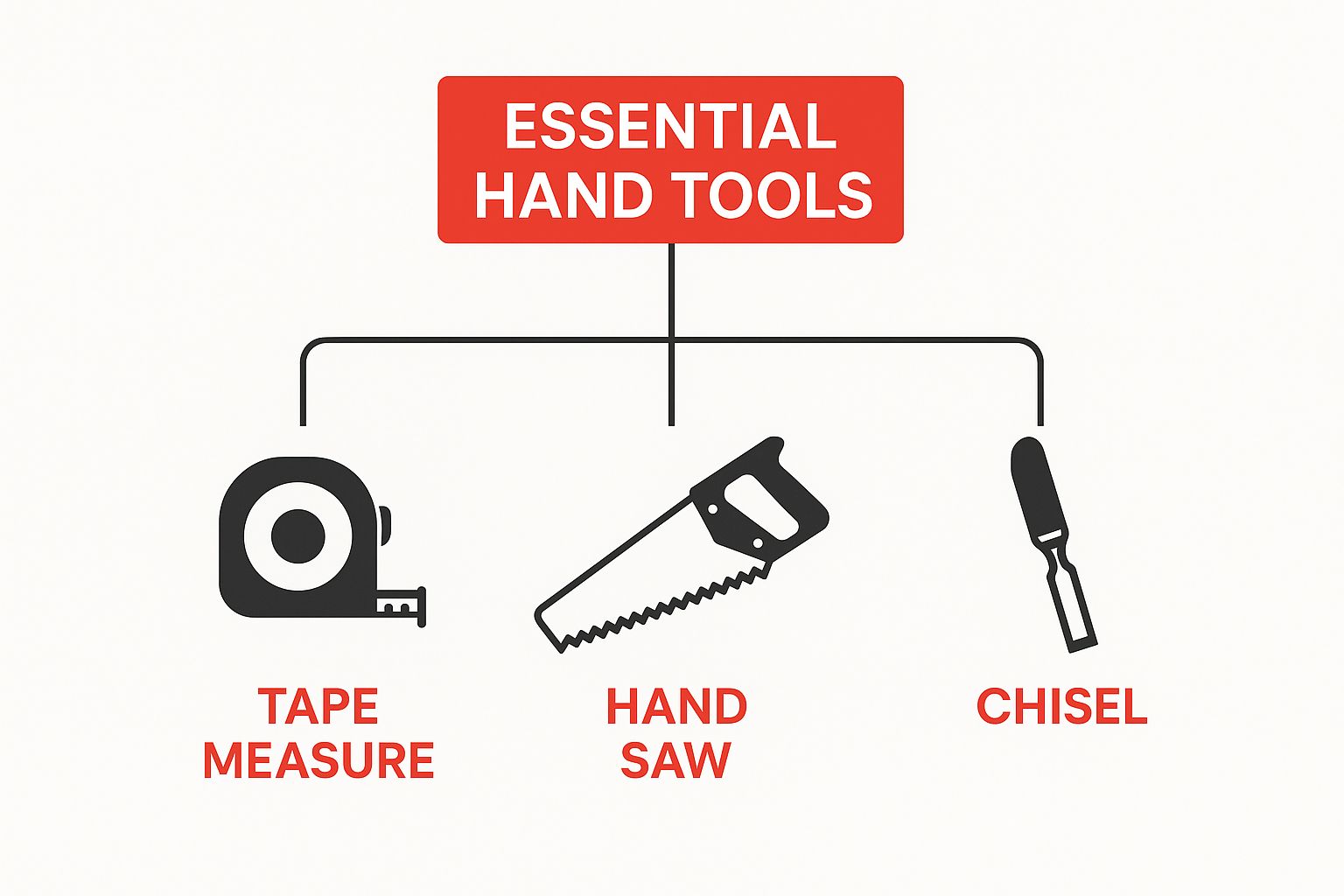
As you can see, everything starts with accurate measurement. From there, you move on to cutting and shaping the wood with confidence.
Your Top 5 Essential Tools for Day One
To get you started on the right foot, here's a quick look at the five tools that should be at the top of your shopping list. These are the workhorses you'll reach for again and again.
| Tool Name | Category | Primary Use | Beginner-Friendly Feature |
|---|---|---|---|
| Cordless Drill | Power Tool | Drilling holes & driving screws | Adjustable clutch prevents over-tightening screws |
| Circular Saw | Power Tool | Making straight cuts in wood | Portable and far more versatile than a hand saw |
| Tape Measure | Hand Tool | Measuring length, width, and thickness | A sturdy 25-foot model is the industry standard |
| Combination Square | Hand Tool | Checking for square & marking 90/45-degree angles | All-in-one tool for ensuring perfect angles |
| Claw Hammer | Hand Tool | Driving & removing nails | The curved claw makes pulling nails nearly effortless |
With just these five tools, you'll have a surprisingly capable setup, ready to tackle a huge range of introductory projects. Now, let’s dig into each one a little deeper.
Mastering Craftsmanship With Essential Hand Tools
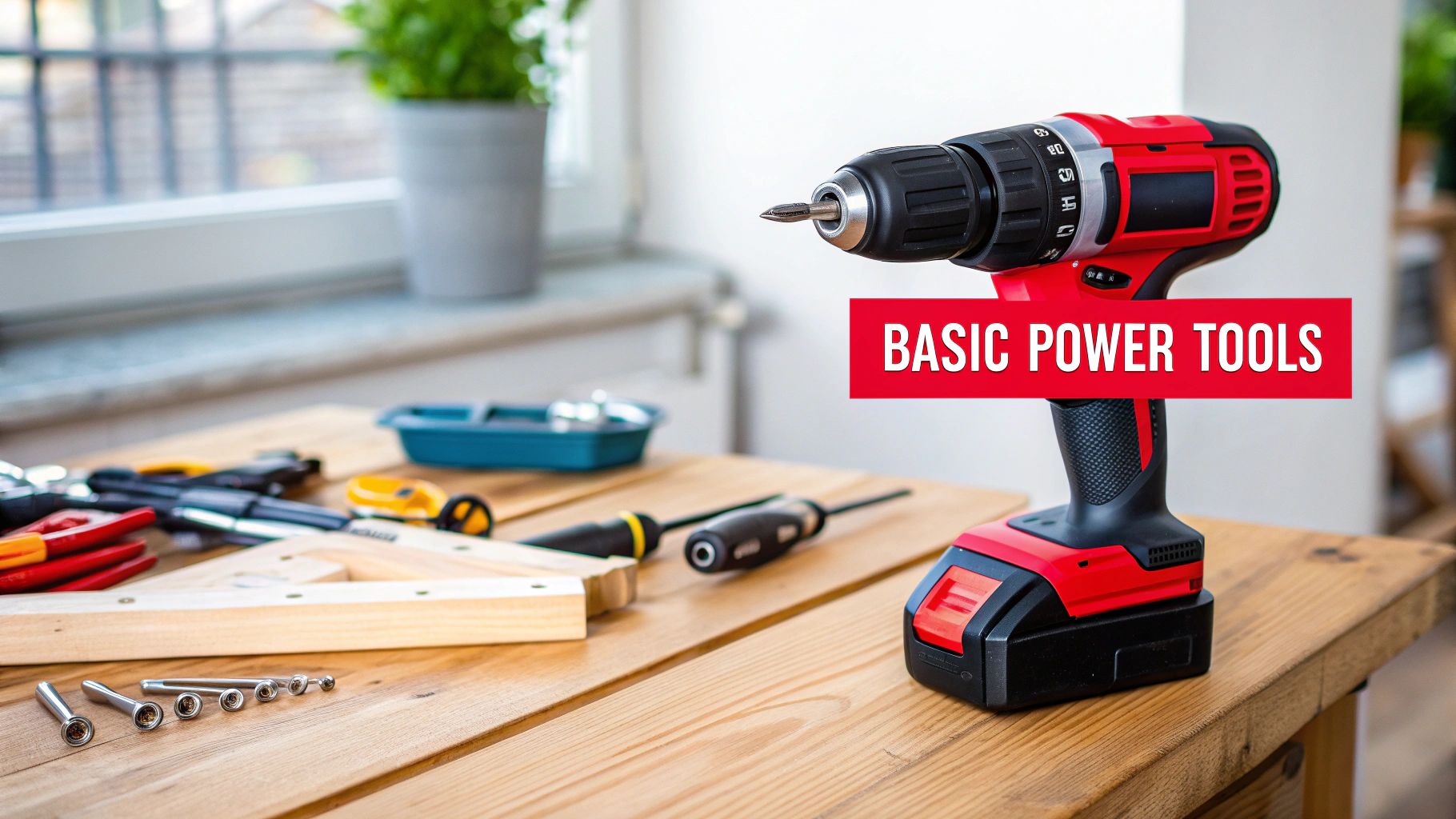
Before you ever plug in a single power tool, the best place to start is with the tools that put you in direct contact with the wood. Hand tools aren't just old-fashioned relics; they're the ultimate teachers. They teach you patience, precision, and what it really feels like to work with the grain. They make you slow down, pay attention, and truly understand how wood wants to behave.
Think of it this way: power tools are the brute force, the engine that gets you from A to B quickly. Hand tools, on the other hand, are your steering and finesse. They give you the nuanced control for those tiny, critical adjustments that separate a decent project from a truly beautiful one. Getting good with these foundational tools builds a kind of muscle memory and intuition that you’ll never get from power tools alone.
The Foundation of Accuracy and Force
Every single project, no matter how complex, boils down to two simple things: measuring right and putting things together. This is where a trusty tape measure, a square, and a good hammer become your best friends in the shop.
The claw hammer is one of the most common tools in the world for a good reason. A solid 20-ounce claw hammer gives you the perfect balance of heft for driving nails and control for pulling them out when things don't go as planned. Precision is just as crucial. Being off by even 1/8-inch can create a cascade of errors that can wreck an entire project. One of the smartest early investments you can make is a quality tape measure with a hook that doesn't wobble. If you want to dig deeper, you can find great insights on top woodworking tools to compare features.
"Measure twice, cut once" isn't just a folksy saying—it's the golden rule. Your tape measure and square are what stand between you and a pile of expensive firewood. They ensure every piece fits exactly how you envisioned it.
These simple tools are your first defense against frustration. A good combination square does more than just draw 90-degree lines; it's how you verify that your cuts are true, your joints are square, and your entire project is built on a solid, stable foundation.
Shaping and Securing Your Work
Once you've got your pieces marked and measured, it's time to start shaping them. This is where hand saws and chisels come in—think of them as the artist's brushes in the woodworking world. They allow you to create joints and refine surfaces with a level of detail that big machines just can't touch.
- Hand Saws: Learning to saw a straight line by hand is a fundamental skill. It teaches you how to follow a mark perfectly, which makes you far more accurate when you eventually move on to power saws.
- Chisels: There's nothing like a freshly sharpened chisel for cleaning up a joint, paring away a paper-thin shaving, or carving out a detail with surgical precision. They're absolutely essential for fine-tuning connections.
Finally, you need to hold everything together while you work. Clamps are the unsung heroes of any workshop, acting as a tireless third hand. They hold your workpiece steady for a cut, keep a joint tight while the glue sets, and make sure everything stays perfectly aligned. Trust me, you can never have too many clamps; they are absolutely critical for getting strong, seamless results.
Adding Power to Your Workshop
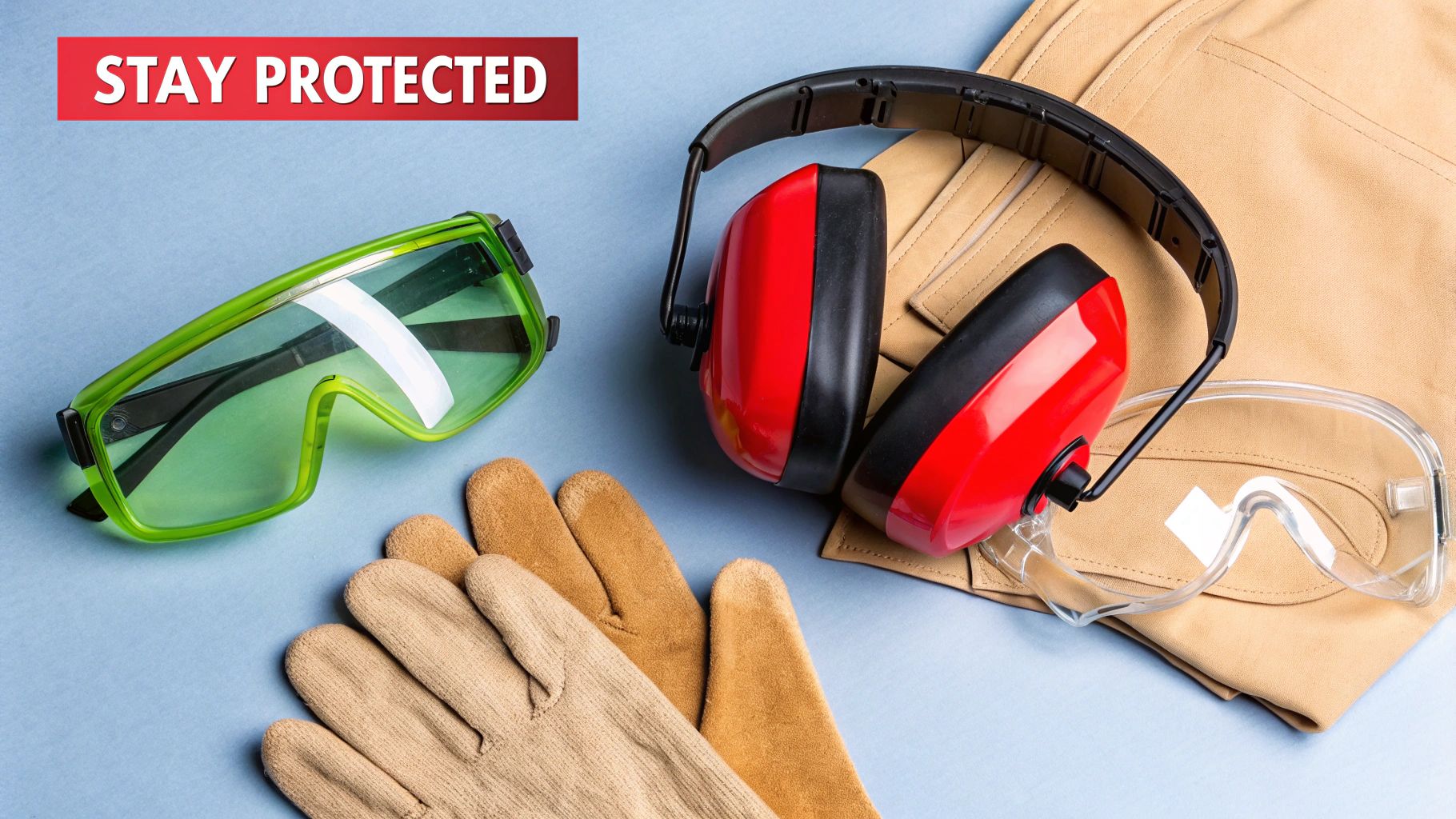
Hand tools are fantastic for learning the fundamentals of wood—its grain, its feel, its stubbornness. But when you’re ready to get serious, power tools are where the magic happens. They’re the engines of the workshop, bringing a level of speed and efficiency that muscle power simply can’t match.
Introducing just a few core power tools will dramatically expand the kinds of projects you can tackle. Don't let the noise and sawdust fool you; modern tools are safer and more user-friendly than ever before. They empower you to make perfectly straight cuts, drill precise holes, and sand surfaces to a glassy finish, taking your work from simply "handmade" to truly "hand-crafted." The trick is to start with the right ones.
Your First and Most Versatile Power Tool
If you only have the budget for a single power tool, make it a cordless drill. It’s hands-down one of the best woodworking tools for beginners because it does so much more than just drill holes. It drives screws, buffs out small imperfections, and even stirs finishes with the right attachments. It’s the tool you’ll reach for constantly.
Think of it as the hub of your growing collection. When you're ready to buy, here’s what to look for:
- Adjustable Clutch: This is a non-negotiable feature. It stops the drill bit from turning once a screw is snug, saving you from the frustration of stripping the screw head or burying it too deep in your beautiful workpiece.
- Variable Speed Trigger: This gives you delicate control. You can start a screw slowly to get it seated properly, then ramp up the speed to drive it home.
- Keyless Chuck: Long gone are the days of hunting for a chuck key. This feature lets you swap out bits in seconds, keeping your workflow smooth and uninterrupted.
A good cordless drill doesn't just make assembly faster—it changes your entire approach to building. Joints become stronger, projects come together with less fuss, and your confidence skyrockets with every screw you drive.
Making Clean Cuts with a Circular Saw
Once you’re set up with a drill, the next powerhouse to add to your arsenal is a circular saw. This is your go-to for breaking down big, unwieldy sheets of plywood or making long, straight cuts on boards. While you can do this with a hand saw, a circular saw delivers crisp, accurate results every single time, with a fraction of the effort.
For a beginner, a corded 7-1/4 inch model is a perfect starting point. It has plenty of muscle for most jobs and is one of the most affordable entry points into serious woodworking.
Achieving the Perfect Finish
The final piece of the puzzle is giving your projects a professional, silky-smooth feel. That's where a random orbital sander comes in. Hand sanding certainly has its place for fine detail work, but for smoothing large surfaces, nothing beats this tool.
It removes material quickly and, more importantly, evenly. Unlike other types of sanders, it won't leave behind the tell-tale swirl marks that can ruin a finish. It’s the difference between a project that looks great and one that feels incredible to the touch. Together, these tools form a trifecta of workshop efficiency. For a look at what the pros use day-in and day-out, check out our guide on the must-have tools for contractors.
Working Safely With Essential Protection
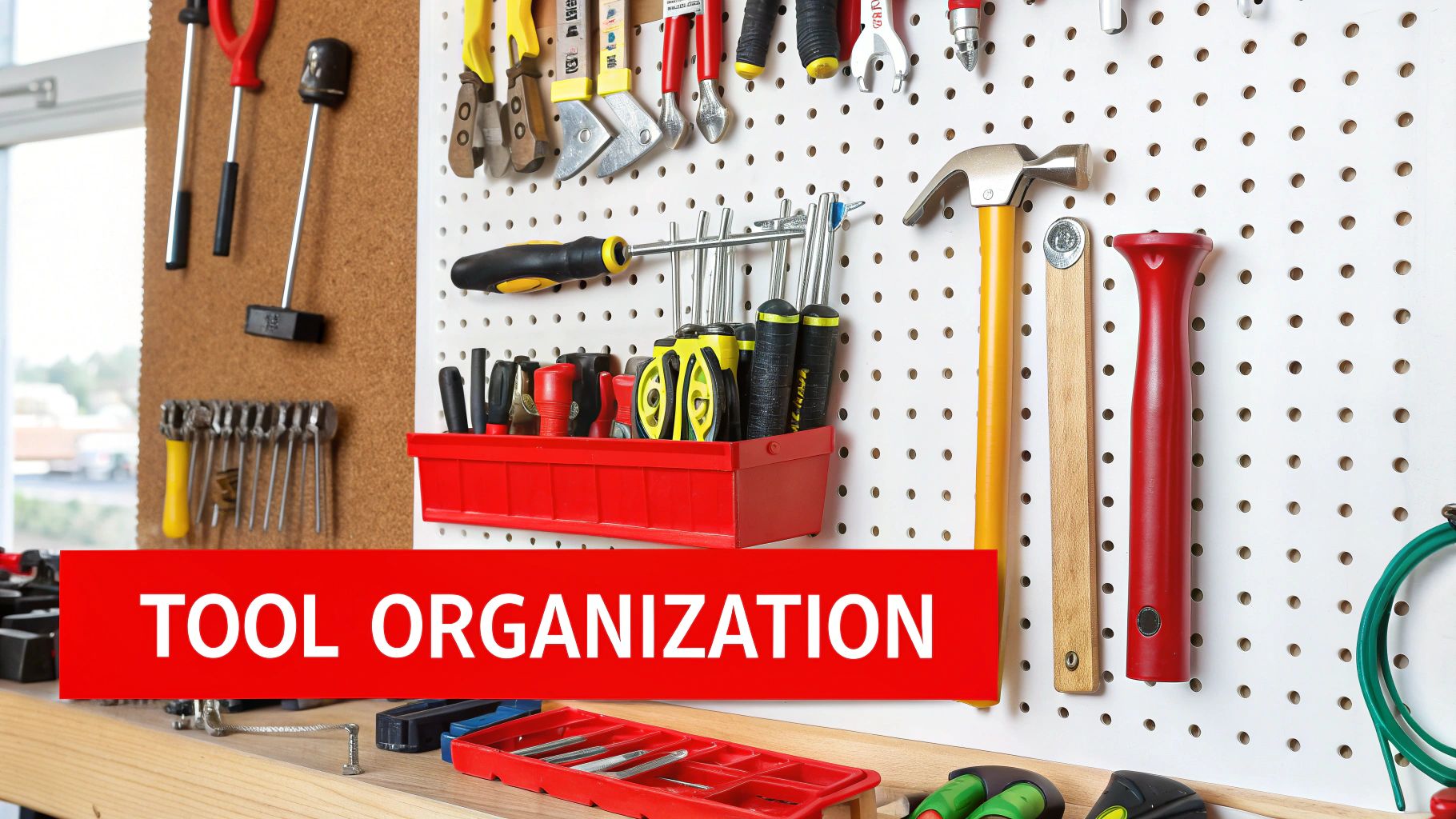
There's nothing quite like the feeling of creating something beautiful from a simple piece of wood. But let's be clear about one thing before you ever make that first cut: the workshop can be an unforgiving place. Safety isn't just a suggestion or an afterthought—it's the bedrock of everything we do in woodworking.
Honestly, you can have the fanciest tools on the market, but they're worthless if you can't use them safely.
Think of your safety gear as the most crucial set of tools in your entire collection. This is the equipment that guards your most precious assets: your eyes, your ears, and your lungs. Building the habit of gearing up every single time you step into the shop is non-negotiable. It's what separates a hobbyist from a craftsperson.
Protecting Your Eyes and Hearing
Your eyes are irreplaceable. It only takes a split second for a flying wood chip, a cloud of dust, or a piece of a shattered blade to cause permanent damage. This is why a solid pair of safety glasses or goggles is your absolute first line of defense. And no, your sunglasses won't cut it—these are specifically engineered to take a hit.
- Safety Glasses: These are your go-to for most general work. They’re great at stopping debris flying straight at your face. Just make sure you grab a pair with an ANSI Z87.1 rating. That stamp means they’ve been tested to meet high-impact safety standards.
- Goggles: For more serious protection, goggles are the way to go. They form a complete seal around your eyes, which is a lifesaver when you're using tools that kick up a ton of fine dust. They're also essential when you're working underneath a project where things could fall. For a solid option that gives you full coverage without feeling bulky, you might check out something like these low-profile Milwaukee goggles.
Your hearing is just as important. That constant drone from a sander or the sudden roar of a circular saw adds up over time, causing cumulative hearing loss. Even tools that don't seem all that loud can cause damage with enough exposure. A simple set of foam earplugs or a comfortable pair of earmuffs is a tiny investment for your long-term health.
Treat your Personal Protective Equipment (PPE) with the same respect as your sharpest chisel. It's the barrier that stands between you and a trip to the emergency room, ensuring you can enjoy woodworking for a lifetime.
Breathing Clean Air
Finally, let's talk about the invisible threat in the workshop: sawdust. As much as we all love the smell of freshly cut wood, breathing in those fine particles is a serious hazard for your respiratory system. It’s not something you’ll feel right away, but over time, it can lead to major health issues.
A good-quality dust mask or respirator is absolutely essential, especially when you're sanding or making a lot of cuts. You'll want to look for one with an N95 rating, which certifies that it filters out at least 95% of those tiny airborne particles. It's a simple, comfortable piece of gear that protects you from a danger you can't even see, making it one of the smartest investments a new woodworker can make.
Making Smart Purchases for Your Workshop
Let's be honest, your budget is one of the most important tools you have. Using it wisely is the key to building a capable shop without falling into the classic beginner traps of overspending on the wrong things. Smart choices now set you up for success down the road, turning every dollar into a real investment in your craft.
One of the first big decisions you’ll face is the age-old corded vs. cordless debate. This isn't about which one is "better" overall, but which is the right fit for a specific tool and how you plan to use it.
The Corded vs. Cordless Dilemma
Cordless tools offer pure freedom. Nothing beats the feeling of grabbing a drill and moving around a project without being tethered to a wall. It's a game-changer for tools you'll be carrying around constantly. Of course, that amazing convenience comes at the cost of battery life and, sometimes, raw, sustained power.
Corded tools, on the other hand, are the tireless workhorses of the shop. They deliver consistent, unrelenting power all day long. This is absolutely critical for tools that run for long stretches, like a sander smoothing a tabletop or a circular saw ripping through thick sheets of plywood. You’ll never have to stop a critical cut because a battery died. A great example of a tool built to just keep going is the Milwaukee M18 FUEL Hammer Drill, which is designed for tough, demanding jobs.
For anyone starting out, a hybrid approach is usually the smartest play. Go cordless for the convenience of your drill/driver, but strongly consider a corded circular saw to guarantee you have all the muscle you need, right when you need it.
Finding Value in Used Tools
Building out your workshop doesn't mean everything has to come shiny and new in a box. The secondhand market can be a goldmine for finding some of the best woodworking tools for beginners at a huge discount—if you know what to look for.
Here’s a quick guide to navigating the used tool market:
- Safe Bets to Buy Used: Simple, sturdy hand tools are fantastic secondhand finds. Think hammers, chisels, quality clamps, and hand planes. They have very few (if any) moving parts, so what you see is what you get.
- Inspect with Caution: When you're looking at a used power tool, you must test it. Plug it in and let it run. Listen for strange grinding noises, feel for excessive vibration, and give the power cord a thorough inspection for any frays or damage.
- Always Buy New: Your safety is non-negotiable. Always buy items like safety glasses, dust masks, and saw blades brand new. This ensures they're in perfect condition and meet all current safety standards.
Growing Your Workshop: What to Buy Next
After you’ve got a few projects under your belt and feel comfortable with your starter tools, you'll start getting bigger ideas. You'll hit a point where you know what you want to build, but your current tools are holding you back. That's the perfect time to start thinking about what comes next.
The goal isn't just to buy more stuff. It's about making smart investments that open up a whole new world of creative possibilities.
Stepping Up Your Power Tool Game
As your projects get more ambitious, you'll feel the limits of your basic setup. Maybe you're getting frustrated trying to make a perfectly straight cut on a long board, or you're tired of fussing with a protractor to get a clean angle. That frustration is your sign to upgrade.
Here are a few game-changers to consider when you're ready to level up. These are some of the best woodworking tools for beginners who are serious about taking their craft to the next level.
-
Miter Saw: Ever tried making a picture frame and struggled to get those 45-degree corners to meet up perfectly? A miter saw solves that problem instantly. It’s designed to make incredibly accurate, repeatable crosscuts and angled cuts, making projects like frames, trim, and boxes a breeze.
-
Table Saw: Ask any seasoned woodworker, and they'll likely tell you the table saw is the heart of their shop. It’s the king of ripping long boards to a precise width and is indispensable for safely and accurately cutting down large sheets of plywood. It's a big step up, but it becomes the central workhorse for almost everything you do.
-
Router: This is where the real magic happens. A router is your go-to for adding professional-looking details to your work. With one, you can shape decorative edges, carve strong joints like rabbets and dadoes, and even inlay intricate designs. It's an incredibly versatile tool that turns a simple box into a work of art.
Your projects are the best guide for your next purchase. Listen for that little voice in your head that says, "If only I could..." That's your cue to start looking for the tool that fills in the blank.
Building your workshop this way—based on what you actually need—is the smartest way to go. You won’t waste money on tools that just sit on a shelf collecting dust. Instead, every new piece of equipment will directly help you grow as a woodworker, giving you the power to bring more challenging and rewarding projects to life.
Your Woodworking Questions, Answered
Jumping into a new craft always sparks a few questions. It’s completely normal. Let's tackle some of the most common ones I hear from people just starting out, so you can get past the confusion and get right to the good stuff—making sawdust.
If I Can Only Buy One Tool to Start, What Should It Be?
This is the classic question, and my answer is always the same: a good cordless drill. No other tool comes close in terms of sheer versatility.
You'll grab it for drilling pilot holes (a non-negotiable for preventing wood from splitting), driving screws, and with the right attachments, even for small sanding jobs. Think of it as the workhorse of your future workshop. It’s the tool you’ll use on your first project and every single one after that.
A great cordless drill is the difference between fumbling with a screwdriver for an hour and assembling a project with strong, clean joints in minutes. It's the tool that bridges the gap between idea and reality.
Do I Need a Big, Fancy Workshop?
Absolutely not! Forget the sprawling workshops you see on TV for now. Most of us got our start in the corner of a garage, a basement, or even just working on a patio on a sunny day.
You don't need a huge space, just a smart one. Focus on three essentials:
- A solid, stable surface to work on.
- Good, bright lighting so you can see what you're doing.
- Decent ventilation to keep the air clear.
In fact, building your own simple workbench is one of the best first projects you can possibly take on. Start where you are, with what you have.
Should I Splurge on Expensive, Pro-Level Tools Right Away?
Please don't. It's one of the biggest mistakes beginners make. While those top-of-the-line brands are fantastic, they're overkill when you're just learning the ropes.
Stick with reputable, mid-range brands that offer a great balance of performance and price. Your focus should be on tools that are reliable, safe, and feel good to use. It’s much wiser to invest in a solid, affordable starter set and then, as your skills grow, upgrade the specific tools you find yourself using the most.
Ready to gear up? Tool Kingdom has everything you need to build that first essential toolkit, from powerful drills to the safety gear you can't work without. Check out our curated starter collections and get building today.
Similar Posts
-

Best Woodworking Tools for Beginners
Discover the best woodworking tools for beginners. Our guide covers the essential hand and power tools to launch your craft with skill and confidence.
-

Must Have Tools for Contractors: Essential Gear for Success
Discover must have tools for contractors to boost efficiency and profits. Find the top essentials to succeed on every job site today!


Leave a comment